
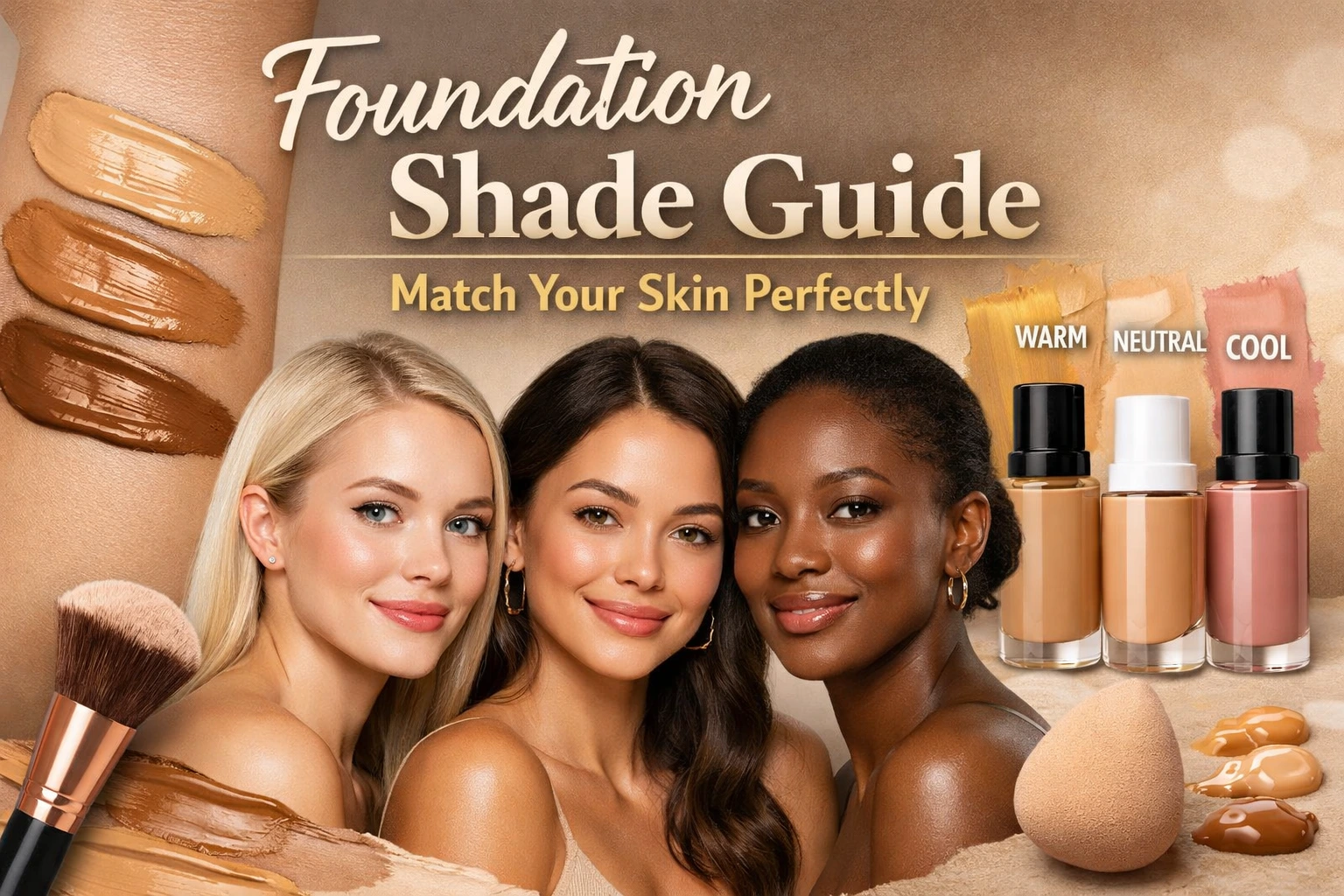

Standing in the makeup aisle — or scrolling through an online beauty store at midnight — staring at dozens of foundation shades with names like “Warm Sand,” “Golden Ivory,” and “Soft Porcelain” is genuinely overwhelming. None of those names tell you anything useful about whether the formula will actually match your skin. If you have ever brought a foundation home only to discover it looks completely wrong in natural light, you are in good company. It is one of the most common makeup mistakes beginners make, and it is entirely fixable.
This guide breaks down exactly how to find your foundation shade — from understanding your skin tone and undertone, to testing swatches correctly, to adjusting for the seasons. By the time you finish reading, you will have a clear, confident system for picking the right shade every single time, whether you are shopping in store or online.
Testing multiple shades on your jawline in natural light is the most reliable way to find your perfect foundation match.
Why Getting Your Foundation Shade Right Actually Matters
Foundation is one of those products where the difference between the right shade and the wrong one is immediately visible — and not in a subtle way. A shade that is too light makes your face look washed out or ghostly against your neck. A shade that is too dark creates an obvious mask effect along your jawline. A shade with the wrong undertone can leave your complexion looking orange, ashy, or muddy even if the depth is otherwise correct.
When the shade is right, something almost magical happens — the foundation simply disappears into your skin. People will compliment your complexion without being able to pinpoint that you are wearing makeup at all. That seamless, second-skin finish is the goal, and it starts entirely with understanding shade science before you open a single bottle.
Step One: Understand the Difference Between Skin Tone and Undertone
Before you test a single swatch, you need to understand two very different concepts that both play a role in finding your foundation shade. Most beginners conflate them, and that is where the confusion starts.
What Is Skin Tone?
Skin tone refers to the surface colour of your complexion — the overall lightness or darkness determined by the amount of melanin in your skin. Most foundation ranges group skin tones into four broad categories: fair, light, medium, and deep. Within each of those categories there are additional gradations, which is why foundation ranges can contain 30 or more shades.
To identify your skin tone, look at your bare, clean face in natural daylight near a window. Avoid artificial lighting, which distorts colour significantly. Assess the overall depth — where does your complexion sit on the spectrum from very pale to very rich and deep? That assessment gives you your starting point for narrowing down shade options.
What Is Skin Undertone?
Undertone is an entirely separate concept from skin tone, and it is arguably more important when it comes to shade matching. Your undertone is the subtle colour that exists beneath the surface of your skin — a warm, cool, or neutral hue that influences how your complexion interacts with makeup, clothing, and lighting.
Crucially, your undertone does not change with seasons, sun exposure, or skincare. While your skin tone might shift a few shades darker in summer and lighter in winter, your undertone remains fixed. This makes it the most reliable factor to identify first.
The three undertone categories are:
- Warm undertones — yellow, golden, or peachy hues beneath the skin. Warm-toned people tend to tan easily and look best in earthy, golden jewellery.
- Cool undertones — pink, red, or bluish hues beneath the skin. Cool-toned people often burn more easily and tend to suit silver jewellery.
- Neutral undertones — a balanced mix of warm and cool, without a strong lean in either direction. Neutral-toned people can often wear both gold and silver comfortably.
Step Two: Identify Your Undertone at Home
There are several reliable tests you can do at home without needing to visit a beauty counter or spend any money. Use more than one method and look for consistent results — that consistency will confirm your undertone with confidence.
The Vein Test
Look at the veins on the inside of your wrist in natural daylight. If they appear predominantly blue or purple, your undertone is cool. If they look greenish, your undertone is warm. If you genuinely cannot tell — or see a mix of both — your undertone is likely neutral. This is one of the quickest and most popular methods, though it works best in good natural light.
The White Paper Test
Hold a plain white piece of paper next to your bare, makeup-free face in natural light near a window. Look at how your skin reacts against the pure white. If your skin appears yellowish or golden next to the white paper, you have a warm undertone. If it looks pinkish, rosy, or slightly bluish, your undertone is cool. If your skin simply looks like skin without a noticeable colour cast, you are likely neutral.
The Sun and Tan Test
Think about how your skin behaves in the sun. Warm-toned individuals tend to tan relatively easily and develop a golden or olive tone. Cool-toned individuals are more prone to burning and may turn pink or red rather than tan. Neutral-toned people often tan moderately with some burning.
The Jewellery Test
Consider which metal tends to look more flattering against your skin. If gold jewellery makes your complexion look lit from within, you are likely warm. If silver jewellery suits you better and gold looks a little heavy or off, your undertone is probably cool. If both look equally good on you, neutral is your undertone.

Foundation shades are grouped by undertone family — warm, cool, and neutral — making it easier to narrow your options once you know your undertone.
Step Three: Decode Foundation Shade Labels
Once you understand your undertone, reading foundation shade labels becomes significantly easier. Many brands use a letter system alongside the shade name or number to indicate the undertone family. The most common labelling conventions you will find across Western beauty brands include:
- W or Y — Warm or Yellow undertone
- C or P — Cool or Pink undertone
- N — Neutral undertone
- O — Olive undertone (a warm-neutral combination common in Mediterranean and some Asian complexions)
A shade labelled “3W” or “220W,” for example, indicates a medium depth with a warm undertone. A shade labelled “2C” or “120C” suggests a light depth with a cool undertone. Once you identify both your depth and your undertone, you can navigate any foundation range with clarity rather than guessing.
It is worth noting that shade naming conventions are not universal across brands. “Beige” in one brand’s line might correspond to “Sand” or “Ivory” in another. Always cross-reference the undertone letter and depth number rather than relying on the descriptive name alone. You can also explore the full range of beauty products available in our Makeup section for additional product guidance.
Step Four: Swatch Test Correctly
This is the step most beginners get wrong — and it is the single most important part of finding your shade. Even with a perfect understanding of undertone and depth, you still need to physically test the foundation on your skin before committing to it. Here is the correct technique.
Always Swatch on Your Jawline
The jawline is the correct testing location — not the back of your hand, not your inner wrist, and not the inside of your forearm. The skin on these areas can differ significantly from your face and neck in both tone and texture. Your jawline sits between your face and your neck, which means a shade that blends seamlessly there will transition naturally in both directions.
Select two or three shades that appear close to your depth, keeping your undertone in mind. Apply a short stripe of each shade side by side on your jawline, leaving a small gap of bare skin between each swatch. Allow the swatches to sit for at least five to ten minutes before assessing them — this gives the formula time to oxidise and settle, which can change how the shade looks on your skin.
Check in Natural Daylight
Never make your final decision under in-store lighting or bathroom lighting. Both artificial light sources distort colour perception significantly. Step outside or stand near a window in natural daylight and assess the swatches from there. The shade that disappears most seamlessly into your skin — where you almost cannot see where the swatch begins and ends — is your match.
The Cotton Swab Trick
Once you have identified your best candidate from the jawline swatches, fill in a slightly larger section of your jaw with that shade and run a cotton swab soaked in makeup remover down the centre. If the colour of the revealed skin matches the shade left on either side, you have found your perfect match.
Step Five: Consider Formula and Finish
Shade matching is only part of the equation. The formula and finish of a foundation also affect how it looks on your skin once applied, and choosing the wrong formula can undermine even a perfectly matched shade.
Coverage Levels
Beginners often assume more coverage is better, but that is not always the case. Sheer coverage is ideal if you want a skin-like, barely-there finish that evens things out without masking your natural texture. Medium coverage is the sweet spot for most beginners — it conceals minor redness and uneven tone without looking heavy. Full coverage provides a more opaque, polished finish and is best suited for special occasions or if you have more significant skin concerns to address.
Finish Types
Foundation finishes fall into three main categories: matte, satin, and dewy. Matte finishes control shine and suit oily or combination skin types particularly well. Dewy finishes add luminosity and suit dry or normal skin types. Satin finishes sit between the two — a soft glow without the high shine — and tend to be the most universally flattering for beginners who are unsure of their skin type.
Skin Type Considerations
If your skin tends to be oily, a matte or long-wear formula will help your foundation stay put throughout the day. If your skin is dry, look for hydrating or skin-tint formulas with moisturising ingredients that will not cling to dry patches. Combination skin often benefits from a satin or natural finish formula applied with lighter coverage over oily zones.
For more guidance on building a complete base routine, browse our Beauty category for skincare prep tips that make foundation application easier and more effective.

Natural light is your most honest mirror — always check your foundation in daylight before stepping out.
Step Six: Adjust for the Seasons
Your skin tone is not entirely static. Sun exposure, changes in climate, and even shifts in skincare can affect the surface depth of your complexion throughout the year. Many people find their skin gets noticeably warmer and deeper during summer months and lighter and cooler in winter. This is perfectly normal, and it means your foundation shade may need to shift accordingly.
A practical approach many makeup artists recommend is keeping two shades on hand — one for the cooler months and one that is a step or two deeper for summer. You can mix the two shades on a palette or even in your palm to create a custom match for transitional seasons like spring and autumn. This eliminates the abrupt shift from one fixed shade to another and keeps your base looking natural all year long.
Remember that even when your surface tone shifts, your undertone stays the same. Both shades should still be within the same undertone family — you are simply adjusting the depth, not the warm, cool, or neutral direction.
Common Foundation Shade Mistakes to Avoid
Even with all the right knowledge, certain habits can lead beginners astray. Being aware of these common pitfalls will save you time, money, and more than a few disappointing makeup days.
Testing on the Back of Your Hand
The skin on the back of your hand is almost always a different tone to the skin on your face and neck. Testing there gives you information about a completely different part of your body. Always swatch on your jawline, as covered above.
Skipping the Oxidation Wait
Many foundation formulas oxidise — that is, they react with the oils and chemistry of your skin and shift slightly in colour within the first ten to fifteen minutes of wear. A shade that looks perfect the moment you apply it might turn slightly darker or more orange once oxidised. Always wait before making your final decision.
Shopping in Poor Lighting
Most retail stores use artificial lighting that makes skin look different from how it appears outdoors. Fluorescent or LED lighting in stores can make shades look lighter or cooler than they actually are. Always step into natural daylight to assess swatches before purchasing.
Matching to Your Face Rather Than Your Neck
Many people have slightly different tones on their face — redness on the cheeks, sun exposure on the forehead, or a natural flush around the nose. Matching your foundation to these areas rather than your jawline or neck often results in a shade that is too warm, too pink, or otherwise off. Your neck reflects your true baseline skin tone.
Ignoring Undertone Entirely
Choosing a shade based purely on depth — without factoring in undertone — is the most common cause of foundations looking “off.” A shade can be exactly the right depth but still look completely wrong if the undertone does not align. This is why a cool-toned person wearing a warm-toned foundation of the correct depth will still look orange or muddy.
Best Beginner-Friendly Foundations for Shade Matching
Certain foundation ranges are particularly well suited to beginners because they offer an extensive shade range with clearly labelled undertone families, making the selection process more straightforward. Some of the most recommended options for those starting out in the Western beauty market include formulas from L’Oréal, Maybelline, Fenty Beauty, and MAC — all of which offer broad shade ranges with warm, cool, and neutral classifications clearly indicated. For a deeper dive into product recommendations, the team at Allure regularly publishes tested foundation reviews that cover shade range inclusivity and formula performance across different skin types.
If you are shopping online and cannot test in person, many brands now offer virtual try-on tools powered by augmented reality, as well as shade-finder quizzes that use a series of questions about your skin tone, undertone, and preferences to recommend your closest match. These are not perfect replacements for physical swatch testing, but they are a useful starting point when in-store shopping is not an option.
For a broader look at current makeup trends and must-have products, visit our Shopping category for curated beauty recommendations across all budgets.
Quick-Reference: Foundation Shade Finder Summary
Before moving on to the FAQ, here is a quick summary of the full process so you have a reliable checklist to return to whenever you are shopping for a new foundation:
- Identify your skin tone depth — fair, light, medium, or deep — by looking at your bare face in natural daylight.
- Determine your undertone — warm, cool, or neutral — using the vein, white paper, sun, and jewellery tests.
- Read shade labels by looking for the undertone letter (W, C, N) alongside the depth number.
- Swatch two to three shades on your jawline, wait ten minutes, then check in natural daylight.
- Choose the shade that disappears most naturally into the junction between your face and neck.
- Consider formula and finish based on your skin type and the coverage level you prefer.
- Adjust seasonally by keeping a lighter and deeper shade on hand to blend as your skin tone shifts.
Frequently Asked Questions
How do I know if my foundation shade is too light or too dark?
If your foundation is too light, your face will appear noticeably paler than your neck in natural light, creating a washed-out or ghostly effect. If it is too dark, you will see a visible line of demarcation along your jawline where the foundation does not blend into your neck. The correct shade should transition seamlessly between your face and neck with no visible edge.
Why does my foundation look orange after a few hours?
This is caused by oxidation — the foundation formula reacting with your skin’s oils and chemistry. It is especially common with formulas that have a warm or yellow base. To avoid this, choose a shade slightly lighter or cooler than your immediate match, or look for foundations labelled as “oxidation-resistant.” Waiting ten to fifteen minutes after swatching before assessing the shade will also help you account for oxidation before purchasing.
Should my foundation match my face or my neck?
Your neck is the most reliable guide. The skin on your face often has more redness, discolouration, or sun exposure variation than your neck, which tends to reflect your truest baseline tone. Matching to your neck ensures the foundation blends seamlessly downward and does not create a visible difference between your face and décolletage.
Can I mix two foundation shades together?
Absolutely — and this is a technique many professional makeup artists use regularly. Mixing a slightly lighter and slightly deeper shade lets you dial in a custom match and adjust for seasonal shifts in your skin tone. You can mix directly on the back of your hand or on a palette before applying. Just ensure both shades share the same undertone family so the mixed result stays true to your complexion.
How often should I update my foundation shade?
Reassess your shade at the change of each season, particularly moving into summer and coming out of it in autumn. If you spend significant time outdoors during summer, your skin may deepen by one or two shades. After a winter of reduced sun exposure, your tone may lighten again. A seasonal check-in using the jawline swatch method keeps your base looking natural year-round.
Is it possible to find my foundation shade online without trying it in store?
Yes, though it requires a bit more work. Use the undertone tests described in this guide to establish your undertone with confidence. Then use the brand’s shade finder quiz or virtual try-on tool as a starting point. Read reviews from people who describe similar skin tones and undertones to yours for additional guidance. Many brands also offer sample sizes or flexible return policies specifically to account for the difficulty of online shade matching.